Generic QR code or GS1 Digital Link for product packaging?
The short version: A free QR code generator makes a square that opens a web address. That is enough for a poster. A pack is printed once, stays in circulation for a long time and may soon meet a checkout scanner. For that job the code needs a product identifier, a destination you control and a link that does not break. A GS1 Digital Link supplies all three. Free tools can produce one too, but the maintenance then falls to you.
What a free QR code does, and what it leaves out
A generic QR code contains text, usually a URL. It does not know which product it sits on, who owns the destination or what happens when the page moves. Many free generators also route scans through their own redirect, so the printed code depends on a third party for as long as the pack exists.
None of this is a flaw for a one-off campaign. It becomes a problem when the code is meant to last as long as the packaging.
What a GS1 Digital Link adds
A GS1 Digital Link is a standardised web address that contains a GS1 identifier, usually the GTIN. GS1 Switzerland shows the pattern: a resolver address, the application identifier 01 for a GTIN, then the GTIN itself. The QR code is only the carrier for that address.
The resolver is the part that makes it flexible. It reads the request and sends the scanner to the right destination, depending on the link type, the language and the country. A GS1 Sweden guide describes it as a signpost and explains that the default link can change without touching the code on the pack. On GS1 Switzerland's resolver, only the owner of a GTIN can set up redirections, which is what makes the link verifiable.
The standard is open and international. GS1 first ratified the URI syntax in 2018, and ISO published the method as ISO/IEC 18975:2024. The GS1-Conformant Resolver Standard, now at release 1.2.1 from August 2026, adds the technical rules for resolvers: HTTPS, defined error responses, exactly one default link per product and a public description file.
Why this matters: The code on the pack stays fixed. The content behind it can change as often as you need, and a standard tells every system how to read it.
Why retail scanners care
A plain URL carries no GTIN, so a checkout cannot use it to find the price. A GS1 Digital Link does carry the GTIN, which is why GS1 positions it for the move from linear barcodes to 2D codes.
GS1 Germany expects checkouts to process 2D codes and read at least the GTIN by the end of 2027, with linear and 2D codes appearing side by side during the transition. The GS1 guideline for 2D barcodes at retail POS lists the QR code with a GS1 Digital Link URI as a supported option. It adds that a linear barcode must stay on the pack until about 90 percent of POS scanning solutions can read the new codes. It also recommends that brands use their own domain in the link and redirect to product information rather than treating the link as a web page.
Sunrise 2027 is the name GS1 US uses for this transition. Its guidance says brands do not need every 2D capability by 2027. The first step it names is to add 2D codes to existing packaging and to update existing QR codes to GS1 Digital Link with the product's GTIN.
The shift is already visible in Germany. In March 2026 dm announced a pilot with GS1 Germany that tests 2D codes at the checkout in selected stores. Beiersdorf's 8X4 deodorants are among the first products. Coverage of the pilot reports that more than 70 percent of installed checkout systems in Germany and Europe already have imager scanners.
What the EU rules say about QR codes on packs
Four pieces of EU law matter here. None of them bans a free QR code. All of them reward a code you can control and update.
The packaging regulation. Regulation (EU) 2025/40 applies from 12 August 2026. Article 12 sets a harmonised material-composition label from 12 August 2028, or 24 months after the implementing acts, whichever is later. It lets operators add a QR code that explains what happens to each component. For reusable packaging, the label and a QR code or other "standardised, open, digital data carrier" apply from 12 February 2029, or 30 months after the implementing act. Article 12 also covers extended producer responsibility: it sets 12 February 2027 for identification of packaging in such a scheme and says this identification may only happen through a symbol in a QR code or another standardised, open digital marking technology.
Article 12 contains two rules for any digital information on a pack. Personal data may only be collected for the limited purpose of giving users access to compliance information. And that information must not be shown together with sales or marketing content. A compliance page therefore needs a clean separation from promotions, whatever tool builds it.
The digital product passport. Under the ecodesign regulation, a passport must be linked through a data carrier to a persistent unique product identifier. GS1 in Europe argues in its white paper that a QR code with a GS1 Digital Link meets those requirements, works with a native phone camera without an app and avoids vendor lock-in through open standards. That is GS1's own position. Which products need a passport, and when, depends on product-specific rules, so check your category.
The consumer protection rules on green claims. Directive (EU) 2024/825 applies from 27 September 2026. According to a CMS summary, general environmental claims without substantiating evidence are treated as unfair in all circumstances, and sustainability labels that are not based on a certification scheme or set up by public authorities are banned. If your QR code leads to sustainability content, that content now needs evidence behind it.
Where a free QR code carries risk on packaging
The link breaks and you cannot fix the print. Online content disappears. Pew Research found that 38 percent of webpages that existed in 2013 were no longer available ten years later, and a quarter of all pages from 2013 to 2023 had gone. A pack stays in circulation far longer than a campaign page. With a resolver you control, you change the destination and keep the print. GS1 Switzerland states the same benefit directly: if your own link changes, the codes on the packaging do not have to be replaced.
The checkout cannot use it. Without a GTIN, a generic code has no job at the point of sale. You would add a second code or reprint when your retailer asks for 2D.
Consumers have learned to distrust QR codes. The FTC warnsthat scammers hide harmful links in QR codes and sometimes cover genuine codes with their own. Germany's BSI wrote in April 2026 that AI gives quishing a new dimension. A code that opens an unfamiliar domain looks no different from a fake one. A link on your own domain, tied to your GTIN, gives shoppers something to check.
The destination may not satisfy the rules. A homepage cannot show a verified recycling instruction, a substantiated claim or a passport record. The code is only as useful as what sits behind it.
You depend on a closed service. Open standards exist so that a printed code does not tie you to one vendor. If a tool uses its own scheme, the choice of provider is hard to reverse once the packs are out.
When a free code is the right call
Free is a fair choice when the code is short-lived, when you have a handful of products and one market, and when a person in your team will maintain the resolver setup. GS1 Germany says that converting an identifier into a GS1 Digital Link URL works with free tools and that a free GS1 Germany resolver service is available in Germany. For a small range, that route is legitimate and cheap.
The question then becomes what you build and maintain yourself: links for every GTIN, one destination per market, translated content, and a check that each page meets the rules above. The work grows with the range.
What info.link/labels adds
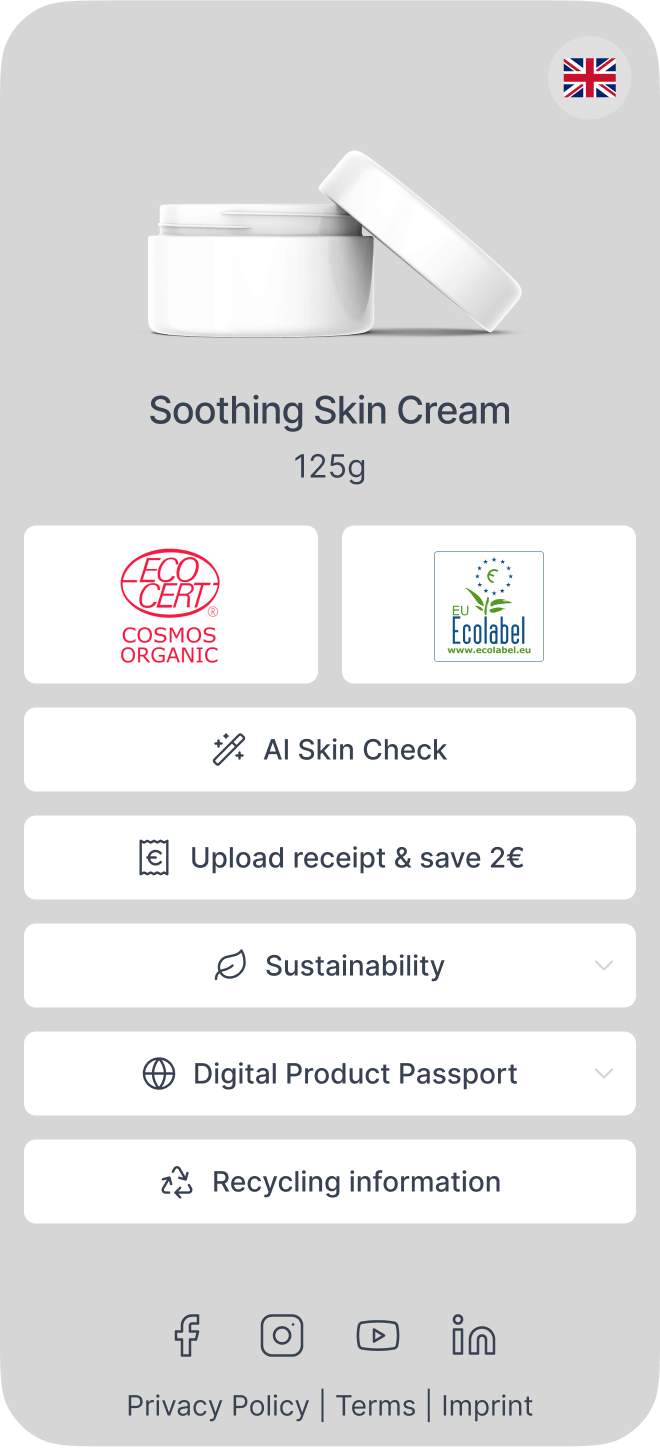
info.link/labels is a digital labelling platform built on the GS1 Digital Link standard. The following points come from the product page and are the company's own statements unless a source says otherwise.
GS1 relationship. In March 2025 butterfly & elephant, the accelerator launched by GS1 Germany, invested in info.link. The stated aim is to embed GS1 standards more deeply into the platform. GS1 Germany's solution provider directory also lists info.link.
Product data from the source. Brands import products by GTIN, CSV, GDSN or PIM. The company says it verifies product numbers through the GS1 interface and pulls in certifications such as EU Ecolabel or Fairtrade when they are on file.
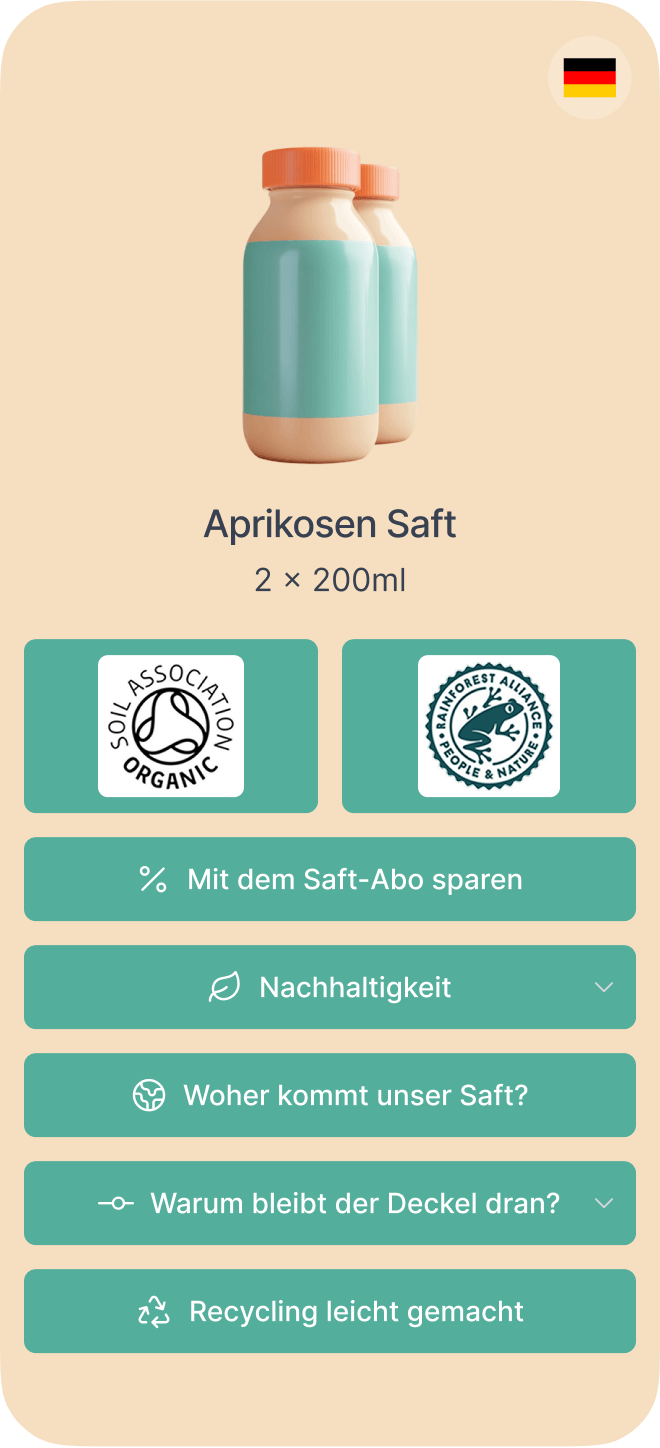
Content that updates. Each label draws on a library of more than 50 templates, with draft and publish states and a change history. The company says it built the platform with the law firms CMS and SKW Schwarz and updates labels when regulations change. Content is served in more than 60 languages through machine translation that editors can edit.
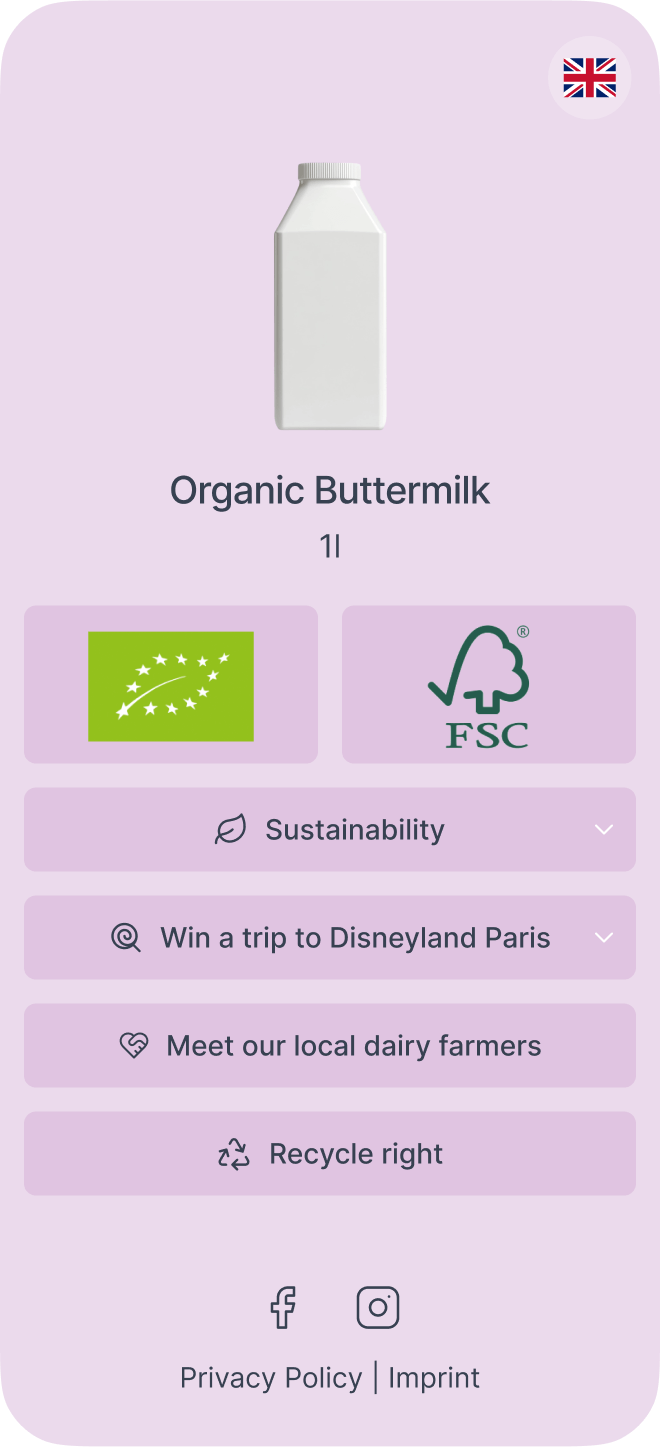
Many jobs, one code. Recycling instructions, claims, manuals, promotions and loyalty run on the same QR code. A Wepa brand manager describes on the company site how 2D codes introduced for compliance became a campaign touchpoint. Keep Article 12 in mind here: compliance information must not be mixed with sales content, so check how a tool separates the two views.
Scale. The company reports more than one billion packs in market. It does not publish an independent audit of that figure.
No tracking, EU hosting. The company states that it uses no cookies and hosts data in the EU. That matters under the personal-data limits of Article 12.
Price. The pricing page lists (Oct. 2026) plans from €79 per month for up to 10 products, €239 for up to 50, €479 for up to 150 and €959 for up to 500, with a custom enterprise tier. Every plan includes GS1 Digital Link QR codes and analytics. Add-ons such as launch support, localisation and custom short links cost extra.
How to decide
Start with the range. One product and one market suggests the free route with a correctly built GS1 Digital Link. Dozens of GTINs, several markets or regulatory content suggest a platform, because the maintenance becomes recurring work.
Then ask five questions of any provider, free or paid. Does the code contain the GTIN in GS1 Digital Link syntax? Who controls the redirect, and is it on your domain? Can the provider show that its resolver follows the GS1-Conformant Resolver Standard? What happens to printed codes if you leave or stop paying? And can the same code serve consumers, retail scanners and regulatory content in every market where you sell?
A provider that answers all five clearly protects your print run. A provider that cannot answer the first two leaves you with a link you do not own.
Bottom line: The code is cheap. The pack is not. Choose the code for the life of the pack.
Sources
GS1 Switzerland, GS1 Digital Link: https://www.gs1.ch/en/products-services/gs1-digital-link
GS1 Sweden, How GS1 Digital Link works: https://gs1.se/en/guides/how-to-guides/how-gs1-digital-link-works/
GS1 Sweden, GS1 Digital Link part of ISO/IEC 18975: https://gs1.se/en/?p=64153
GS1, GS1-Conformant Resolver Standard 1.2.1: https://ref.gs1.org/standards/resolver/
GS1, 2D Barcodes at Retail POS Implementation Guideline 1.1.0: https://ref.gs1.org/guidelines/2d-in-retail/
GS1 US, Sunrise 2027: https://www.gs1us.org/industries-and-insights/by-topic/sunrise-2027
GS1 Germany, 2D-Code: https://www.gs1-germany.de/branchen-themen/zukunft-2d-code/
GS1 Germany, GS1 Digital Link: https://www.gs1-germany.de/standards/datenaustausch/gs1-digital-link/
GS1 Germany, dm pilot (5 March 2026): https://www.gs1-germany.de/newsroom/pressemeldungen/dm-macht-kassen-fit-fuer-2d-codes/
GS1 in Europe, Enabling DPP white paper (July 2024): https://www.gs1-germany.de/fileadmin/gs1/fachpublikationen/GS1-Enabling-DPP-White-Paper.pdf
Retail Optimiser, dm and Beiersdorf pilot (11 March 2026): https://retail-optimiser.de/en/dm-and-beiersdorf-pilot-gs1-digital-link/
Regulation (EU) 2025/40, Article 12, EUR-Lex: https://eur-lex.europa.eu/eli/reg/2025/40/oj/eng
European Commission, packaging waste: https://environment.ec.europa.eu/topics/waste-and-recycling/packaging-waste_en
CMS, Directive 2024/825: https://cms.law/en/int/legal-updates/recent-publication-of-directive-2024-825-on-empowering-consumers-for-the-green-transition
Pew Research Center, When online content disappears (2024): https://www.pewresearch.org/data-labs/2024/05/17/when-online-content-disappears/
FTC consumer alert (December 2023): https://consumer.ftc.gov/consumer-alerts/2023/12/scammers-hide-harmful-links-qr-codes-steal-your-information
BSI, KI-gestützte QR-Code-Betrügereien (1 April 2026): https://www.bsi.bund.de/DE/Service-Navi/Abonnements/Newsletter/Buerger-CERT-Abos/Newsletter-Einfach-Cybersicher/Einfach_Cybersicher_260401/_documents/Basics_3_Quishing.html
info.link, labels: https://info.link/labels
info.link, labels pricing: https://info.link/labels/pricing
info.link, GS1 invests in info.link: https://info.link/resources/gs1-invests-in-infolink
GS1 Germany solution provider directory, info.link: https://en.pine.gs1.de/solution-provider/info-link