Green Dot and EPR Marks in QR Codes: PPWR Rules from 2027

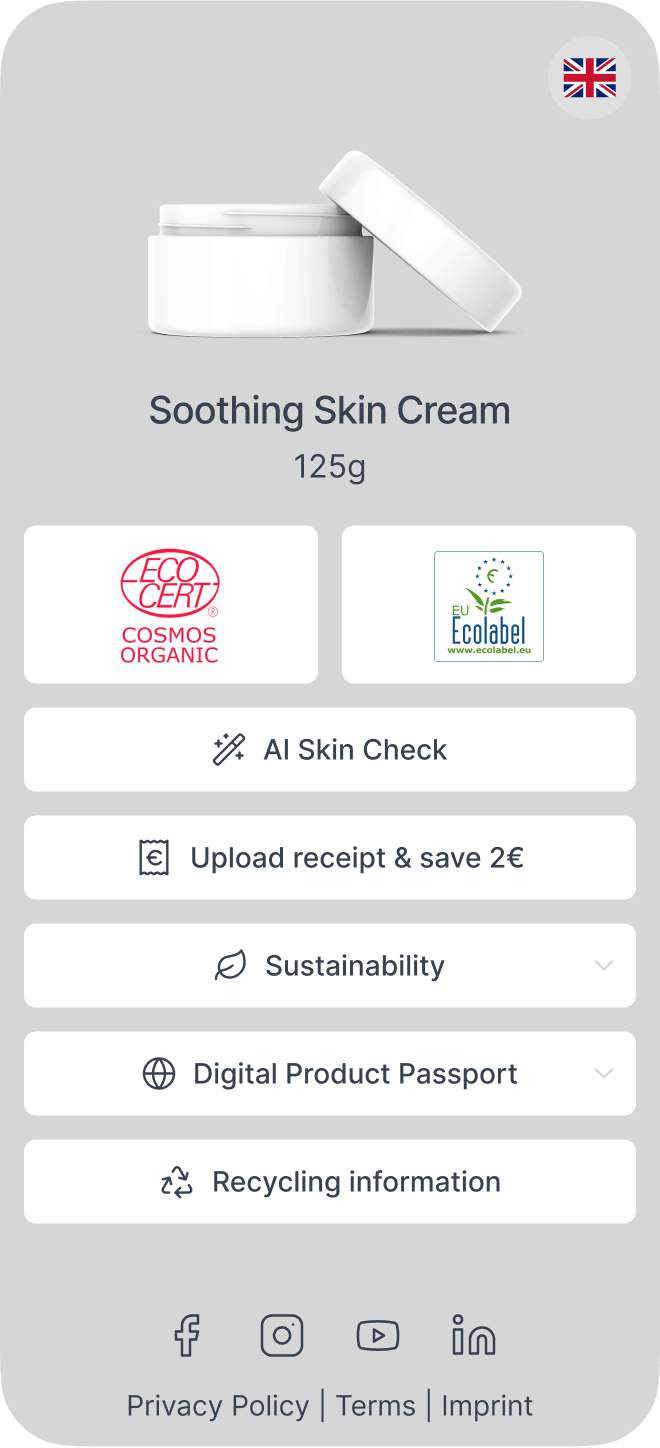
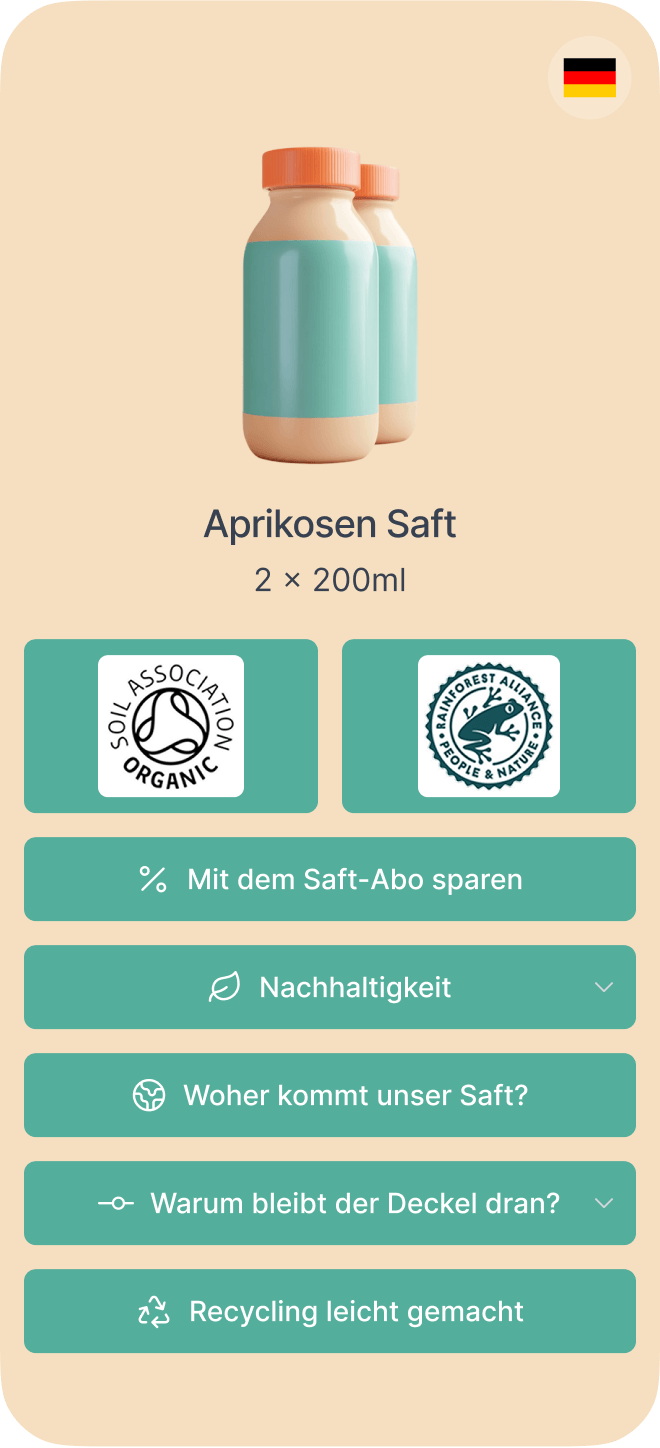
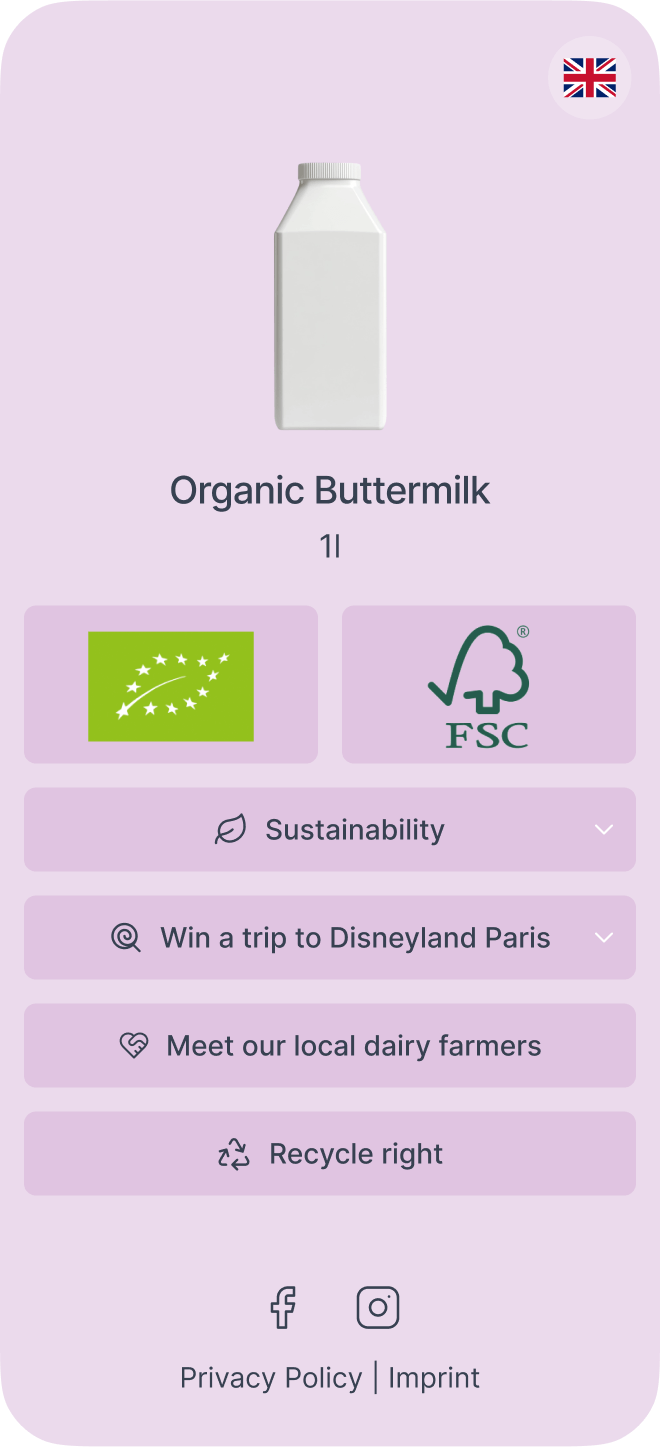
Under Article 12(9) of Regulation (EU) 2025/40 (PPWR), packaging included in an EPR scheme may be identified only by a symbol in a QR code or another standardised, open digital technology. EPR schemes apply this from 12 February 2027 and read it as ending printed EPR marks. Showing EPR membership is optional. Registration and fees stay mandatory. In Germany, breaches can be fined up to EUR 10,000 under § 66 VerpackDG.
What changes for EPR marks on 12 February 2027?
Article 12(9) of the EU Packaging and Packaging Waste Regulation (PPWR), Regulation (EU) 2025/40, sets the rule. It says packaging included in an extended producer responsibility (EPR) scheme "may be identified" in the Member States where the scheme applies. It also says this identification "shall be achieved only by means of a corresponding symbol in a QR code or other standardised, open, digital-marking technology" (European Parliament & Council of the European Union, 2025, Art. 12(9)).
The PPWR is an EU regulation. It applies directly in all 27 Member States and needs no national transposition. It applies in general from 12 August 2026.
The key points:
- Printed EPR marks end. The printed Green Dot and other printed EPR marks are no longer allowed from 12 February 2027. EPR schemes apply the date this way (Altstoff Recycling Austria, 2026a).
- Digital marks stay possible. The symbol may appear inside a QR code or another standardised, open digital technology.
- Showing EPR membership is optional. The text says packaging "may be identified". Your EPR registration and fees stay mandatory.
- The symbol must not mislead. It must be clear and unambiguous. It must not mislead consumers about recyclability or reusability.
- No sell off period. The three year grace period in Article 12(12) covers only the labels in Article 12(1), (2) and (4). It does not cover Article 12(9).
- Other marks stay. Deposit marks and national sorting symbols are not affected by Article 12(9).
Why does the EU regulate EPR marks?
The Regulation gives two reasons. Both are in its recitals, the explanatory part in front of the articles (European Parliament & Council of the European Union, 2025).
The first reason is consumer protection. Recital (71) says consumers should be protected from misleading and confusing information about the characteristics and the end of life treatment of packaging. A symbol that shows a producer fulfils its EPR duties should be "clear and unambiguous" about recyclability. The recital therefore allows such identification only through a QR code or another standardised, open digital technology.
The second reason is label overload. Recital (70) states that there should be "no multiplication of labels on packaging". If other EU law requires product information through a data carrier, the packaging information should be available through the same carrier. Where a digital product passport applies, that passport should also carry the information the PPWR requires.
Article 12(8) backs both points with a general rule. Economic operators may not display labels, marks, symbols or inscriptions that are likely to mislead or confuse consumers about the sustainability requirements, the other characteristics or the waste management options of packaging, where the PPWR sets a harmonised label. In our reading, this means one set of sorting symbols on the pack from 2028 and EPR information behind a QR code.
What are the key PPWR labelling dates?
The EPR mark rule is the first labelling deadline. The harmonised sorting label follows later and depends on an implementing act that the Commission has not adopted yet. The Regulation set 12 August 2026 as the deadline for these acts (Art. 12(6) and (7)). As of 7 October 2026, the Commission lists the act as an upcoming draft with adoption planned for the fourth quarter of 2026 (European Commission, n.d.).
The dates that matter:
- 11 February 2025: The PPWR enters into force.
- 12 August 2026: The PPWR applies in general. Manufacturers must give their name, postal address and contact details on the packaging or in a QR code (Art. 15(6)).
- 31 December 2026: The Commission plans to adopt the calculation and verification method for recycled content (European Commission, 2026b).
- 12 February 2027: EPR marks may only appear digitally (Art. 12(9)). German fines start on this date.
- 12 August 2028: The harmonised sorting label applies, or 24 months after the implementing act, whichever is later (Art. 12(1)). If the Commission adopts the act in the fourth quarter of 2026, the label applies in late 2028 (our calculation).
- 12 February 2029: Reusable packaging needs a reuse label and a QR code, or 30 months after the implementing act, whichever is later (Art. 12(2)).
- 1 January 2030: The Commission must adopt the method for digital marking of substances of concern (Art. 12(7)).
What does Article 12(9) allow, and what does it forbid?
The article has three parts: a time limit, a method and a quality rule (European Parliament & Council of the European Union, 2025).
- Time limit: The article starts with "By 12 February 2027". EPR schemes and the German Packaging Act treat 12 February 2027 as the date from which only digital identification is allowed.
- Method: Identification is allowed "only by means of a corresponding symbol in a QR code or other standardised, open, digital-marking technology". A printed symbol on the pack is not.
- Quality rule: The symbol must be "clear and unambiguous". It must not mislead consumers or other end users about the recyclability or reusability of the packaging.
The purpose is stated in the article itself. The symbol indicates "that the producer fulfils its extended producer responsibility obligations".
Three points often cause confusion:
- It is not a duty to show the symbol. Packaging "may be identified". Brands can leave the mark out.
- It is not a ban on the Green Dot as a brand. The Green Dot is a licensed trademark of Der Grüne Punkt, used under licence contracts (Der Grüne Punkt, n.d.). Article 12(9) governs how the identification appears on the market.
- It is not covered by the grace period. Article 12(12) allows stock made or imported before the deadlines to be sold for 3 years after the labelling requirement enters into force. The article names only paragraphs 1, 2 and 4. Check with your EPR scheme how it treats packaging that is already on the market.
The Commission FAQ of August 2026 contains no text on the EPR mark or the Green Dot (European Commission, 2026b).
How should the QR code for an EPR mark work?
Article 12(9) asks for a "standardised, open" digital technology. It sets no further technical rules for the EPR QR code. The Regulation does set detailed rules for the data carriers of the sorting, reuse and recycled content labels in Article 12(5). They show where the Commission is heading, and they are a sound base for any QR code on packaging (European Parliament & Council of the European Union, 2025).
Article 12(5) requires for these labels:
- Placement: Visible, legible and firmly attached, so it cannot be erased. If that is not possible or not warranted, on the grouped packaging.
- Accessibility: If neither works, or where access for vulnerable groups such as visually impaired persons is relevant, a single electronically readable code.
- Online availability: The information must also be available to end users before purchase in online sales.
- Language: One or more languages that end users easily understand, as set by the Member State where the packaging is made available.
- Data protection: Only the personal data needed to give access to the compliance information may be collected (Regulation (EU) 2016/679, Art. 5(1)).
- No marketing: The information may not be displayed together with sales or marketing content.
- One data carrier: If EU law requires a data carrier for the packaged product, one carrier serves both the product and the packaging information. Both must be easy to tell apart.
For product pages behind a QR code, GS1 Digital Link is the open standard in retail. It encodes the GTIN in a web address, so one printed code can lead to different content by market and language (GS1, n.d.). The Regulation does not name GS1 Digital Link. Check with your EPR scheme which technology it accepts.
What do EPR schemes offer for digital marking?
EPR schemes are the organisations that collect packaging fees and organise recycling. Several have published their position on the 12 February 2027 date.
Der Grüne Punkt and DigiDot. Der Grüne Punkt launched DigiDot, a digital version of the Green Dot, on 12 May 2026. It gives consumers location specific sorting instructions per packaging part. The scheme reports more than 1,000 packaging types and about 50,000 products and coverage of up to 31 countries (Der Grüne Punkt, 2026).
ARA in Austria. ARA offers DigiDot to its customers. A basic version is available through the customer portal, and a product version has more functions (Altstoff Recycling Austria, 2026b). ARA's PPWR guide of August 2026 states that EPR marks may only appear in a QR code from 12 February 2027 and names no transition period. It adds that voluntary material marks such as PAP 21 are no longer allowed once the EU sorting label applies (Altstoff Recycling Austria, 2026a).
What this means for your decision:
- Your EPR scheme is your first contact. It holds your licence and knows its own digital offer.
- Ask which technology the QR code uses and whether the payload is a GS1 Digital Link. We found no public statement on this.
- Ask whether the symbol sits in the code itself or on the page behind it.
- Ask how the scheme treats packaging already on the market on 12 February 2027.
What stays on pack, and what can go digital, by country?
The EPR mark rule is EU wide. Sorting symbols and deposit marks follow national law until the EU sorting label applies. The overview below lists what national authorities and the Commission state.
EU wide: deposit marks. Deposit marks are not harmonised. The mark of the country where the product is made available applies. Member States may not ban the deposit labels of other Member States (Art. 12(10); European Commission, 2026b).
France. Info-tri and the Triman logo are mandatory on household packaging under decree 2021-835 (République française, 2021). The size of the pack decides what may go digital (Adelphe, 2025):
- Above 20 cm²: both stay on pack.
- From 10 to 20 cm²: Triman stays on pack, Info-tri may be digital.
- Below 10 cm²: both may be digital.
The Commission referred France to the Court of Justice of the EU on 17 July 2025. It considers the French sorting labels incompatible with the free movement of goods (Articles 34 to 36 TFEU) (European Commission, 2025). Brands must still follow the French rules today.
Italy. Packaging needs a material code under Decision 97/129/EC and Italian collection information. Digital channels are always allowed and may replace or add to the printed information. The pack or the point of sale must say how to reach it, and a page for the specific pack with easy, direct access is recommended (Ministero dell'Ambiente e della Sicurezza Energetica, 2022).
Spain. Since 1 January 2025, household packaging must show the container or fraction for each material. A QR code is allowed only in three cases: the pack already had one before 2025, the pack is multilingual for several EU states, or the pack is small. Recycling information must appear on the first screen, without marketing content (Ministerio para la Transición Ecológica y el Reto Demográfico, n.d.).
Portugal. Marking is mandatory for drinks cups. The Ecoponto symbol is optional, and destination information may be given by any suitable means (Agência Portuguesa do Ambiente, 2026).
Germany and Austria. No sorting symbol is required by law. Germany requires deposit marking and the EINWEG or MEHRWEG notice (see the next section). Austria requires the deposit logo on single use drinks packaging (Republik Österreich, 2023).
What are the rules and fines in Germany?
Germany enforces Article 12(9) through its Packaging Act (VerpackDG). Breaking Article 12(9) sentence 2 or 3 is an administrative offence. The fine is up to EUR 10,000 and applies from 12 February 2027 (Bundesministerium der Justiz, n.d.).
The details in the statute:
- EPR mark: § 66(2) Nr. 2 covers breaches of Article 12(9) sentence 2 or 3. Under § 66(3), offences that appear in neither the EUR 200,000 list nor the EUR 100,000 list carry a fine of up to EUR 10,000. This offence is in neither list.
- Start date: § 68(17) states that § 66(2) applies only from 12 February 2027. The text contains no warning phase. Enforcement practice is not known yet.
- Authority: The competent administrative authority is set by state law (§ 66(4)). Expect enforcement at the level of the Bundesländer.
- Deposit mark: § 46(1) requires the first distributor of single use drinks packaging to mark it permanently, legibly and visibly as subject to a deposit. A missing or wrong mark can cost up to EUR 100,000.
- Notice at retail: § 47 requires the EINWEG or MEHRWEG notice. A breach can cost up to EUR 10,000.
- Material numbers: § 4 makes material numbers voluntary. If used, only the numbers and abbreviations in Annex 2 are allowed.
- No sorting symbol: The Packaging Act contains no duty to print a sorting symbol.
Which PPWR duties already apply?
The PPWR applies since 12 August 2026. Three duties matter for packaging information today.
Manufacturer details (Art. 15(5) and (6)). Packaging must carry a type, batch or serial number. Manufacturers must give their name, registered trade name or trademark, postal address and, where available, electronic contact details. The postal address must name a single point of contact. The information goes on the packaging or in a QR code. If that is not possible, it goes in a QR code on the grouped packaging or in an accompanying document (European Commission, 2026b).
The Commission FAQ adds two clarifications:
- Packaging produced but not yet placed on the market on 12 August 2026 does not have to be destroyed, remanufactured or relabelled. An accompanying document is enough for these stocks.
- Packaging placed on the market before 12 August 2026 may stay on the market, even if it does not comply with the PPWR.
The food information address does not replace the manufacturer details. The FAQ states that the responsible food business operator and the packaging manufacturer may be different persons. The information required under the Food Information to Consumers Regulation does not necessarily meet Article 15(6).
Misleading marks (Art. 12(8)). Labels, marks and symbols may not mislead consumers about the recyclability, recycled content, reusability, compostability, bio-based content, hazardous substances content or waste management options of packaging (European Commission, 2026b).
Environmental claims (Art. 14). Claims on properties that the PPWR regulates, such as recyclability or recycled content, must go beyond the legal minimum and state whether they refer to the whole pack or to a part. Claims on other properties follow Directive (EU) 2024/825 on empowering consumers for the green transition (same source).
What comes after 2027: the EU sorting label and more
The EPR mark is the first step. The next is a harmonised sorting label that replaces national sorting symbols. It follows the same logic as the EPR rule: fewer symbols on the pack, more information behind a data carrier.
The harmonised sorting label (Art. 12(1)). From 12 August 2028, or 24 months after the implementing act, whichever is later, packaging must carry a harmonised label with pictograms on its material composition. For packaging that is compostable, the label must say that it is compostable, that it is not suitable for home composting and that it must not be discarded in nature. The duty does not apply to transport packaging, except e-commerce packaging, or to packaging in deposit and return systems. Economic operators may add a QR code with destination data for each separate component (European Parliament & Council of the European Union, 2025).
National labels end. The Commission guidance of 5 June 2026 states that Article 12 labelling is exhaustive and fully harmonised. Member States may not keep national sorting labels next to the EU label after it applies, and national rules that add sorting instructions are not allowed. The guidance is not legally binding (European Commission, 2026a).
More labels and dates:
- Recycled content: If you show a recycled content label from the same date, it must follow the implementing act and the calculation method (Art. 12(4)).
- Reuse: From 12 February 2029, or 30 months after the act, reusable packaging needs a reuse label. A QR code or other open data carrier gives information on reuse systems and collection points and allows tracking of trips and rotations. Open loop systems without a system operator are exempt (Art. 12(2) and (3)).
- Substances of concern: The Commission must adopt the digital marking method by 1 January 2030. The marking must include at least the name and concentration of each substance in each material. The European Chemicals Agency is running a study to identify the substances (European Commission, 2026b).
- Waste receptacles: Member States must label collection receptacles with matching harmonised labels from 12 August 2028, or 30 months after the implementing act, whichever is later (Art. 13).
- Medicines and devices: Article 12 does not apply to the immediate and outer packaging of medical devices, in vitro diagnostics and medicinal products if other labelling rules leave no space. For medicinal products it also does not apply where the labelling could jeopardise safe use (Art. 12(11)).
- Sell off: Stock made or imported before the deadlines may be made available for 3 years after the labelling requirement enters into force (Art. 12(12)).
What should brand, product and compliance managers do now?
Use this checklist to be ready before 12 February 2027:
- List every pack, label and artwork file that carries a Green Dot or another EPR scheme mark.
- Remove the printed EPR mark from the next print run. Ask your scheme for its digital option, such as DigiDot in Germany and Austria.
- Decide whether you want to show your EPR membership digitally. Article 12(9) allows it, but does not require it.
- Keep all national marks on pack: deposit symbols, Triman and Info-tri in France, container and fraction marking in Spain, and the material code in Italy.
- Add manufacturer name and contact details as required by Article 15(5) and 15(6). These duties apply since 12 August 2026.
- Use one stable GS1 Digital Link QR code per GTIN, so the same code can serve EPR, sorting and product information in every market. info.link/labels supports this setup.
- Collect component and material data now. You need it for the harmonised sorting label from 2028.
- Watch for the Commission implementing act on harmonised labels, planned for Q4 2026 (European Commission, n.d.).
Sources
- Adelphe. (2025, October). Guide Info-tri [Guide]. https://www.adelphe.fr/sites/default/files/Documents/2025-10/adelphe_guide_info-tri_fr.pdf
- Agência Portuguesa do Ambiente. (2026). Circular 05/2026: Marcação de embalagens [Circular]. https://apambiente.pt/sites/default/files/_Residuos/FluxosEspecificosResiduos/Circulares/circular-05-2026_marcacao_emb.pdf
- Altstoff Recycling Austria. (2026a, August). PPWR Leitfaden [Guide]. https://www.ara.at/uploads/Dokumente/PPWR_Leitfaden/ARA-PPWR-Leitfaden-08_2026.pdf
- Altstoff Recycling Austria. (2026b, May 12). DigiDot, EMPCO und PPWR konform mit dem digitalen Grünen Punkt [News release]. https://www.ara.at/news/digidot-empco-und-ppwr-konform-mit-dem-digitalen-gruenen-punkt
- Bundesministerium der Justiz. (n.d.). Verpackungsrecht-Durchführungsgesetz (VerpackDG) [Statute]. Gesetze im Internet. https://www.gesetze-im-internet.de/verpackdg/
- Der Grüne Punkt. (n.d.). DigiDot: FAQ. https://www.gruener-punkt.de/en/sustainable-packaging/digidot/faq-list
- Der Grüne Punkt. (2026, May 12). QR code based sorting guide: DigiDot now offers EU-wide coverage [News release]. https://www.gruener-punkt.de/en/company/news/details/qr-code-based-sorting-guide-digidot-now-offers-eu-wide-coverage
- European Commission. (n.d.). Packaging and packaging waste: New Commission implementing rules on harmonised labels [Call for evidence, initiative 19243]. https://ec.europa.eu/info/law/better-regulation/have-your-say/initiatives/19243-Packaging-and-packaging-waste-new-Commission-implementing-rules-on-harmonised-labels_en
- European Commission. (2025, July 17). Commission refers France to the Court of Justice over packaging waste rules (IP/25/1834) [Press release]. https://ec.europa.eu/commission/presscorner/detail/en/ip_25_1834
- European Commission. (2026a, June 5). Guidance on the application of Regulation (EU) 2025/40 on packaging and packaging waste (C(2026) 3702). https://eur-lex.europa.eu/legal-content/EN/TXT/PDF/?uri=PI_COM%3AC%282026%293702
- European Commission. (2026b, August). Frequently asked questions on the Packaging and Packaging Waste Regulation (PPWR) (2nd ed.). https://environment.ec.europa.eu/publications/faq-packaging-and-packaging-waste-regulation-ppwr_en
- European Parliament & Council of the European Union. (2025). Regulation (EU) 2025/40 of 19 December 2024 on packaging and packaging waste. Official Journal of the European Union, L, 2025/40. https://eur-lex.europa.eu/legal-content/EN/TXT/HTML/?uri=OJ:L_202500040
- GS1. (n.d.). GS1 Digital Link: URI syntax [Standard]. https://ref.gs1.org/standards/digital-link/uri-syntax/
- Ministerio para la Transición Ecológica y el Reto Demográfico. (n.d.). Nota interpretativa sobre el marcado de envases (versión refundida) [Interpretative note]. https://www.miteco.gob.es/content/dam/miteco/es/calidad-y-evaluacion-ambiental/sgresiduos/envases/Versión%20refundida%20nota%20interpretativa%20marcado%20de%20envases.pdf
- Ministero dell'Ambiente e della Sicurezza Energetica. (2022). Linee guida sull'etichettatura ambientale degli imballaggi [Guideline]. https://www.mase.gov.it/portale/documents/d/guest/linee_guida_etichettatura_ambientale_27-09-2022-pdf
- Republik Österreich. (2023). Verordnung über die Kennzeichnung von Einweggetränkeverpackungen. Bundesgesetzblatt für die Republik Österreich, II(283). https://ris.bka.gv.at/Dokumente/BgblAuth/BGBLA_2023_II_283/BGBLA_2023_II_283.pdf
- République française. (2021). Décret n° 2021-835 du 29 juin 2021 relatif à l'information des consommateurs sur les règles de tri des déchets [Decree]. https://aida.ineris.fr/reglementation/decret-ndeg-2021-835-290621-relatif-a-linformation-consommateurs-regle-tri-dechets
About the author Max Ackermann
Max Ackermann is founder and Managing Director of info.link, the product data platform that makes brands visible in AI search and connects every physical product to the web through GS1 Digital Link. He writes about AI search and generative engine optimization (GEO), AI-powered commerce, and how brands can structure product data for ChatGPT, Gemini, Perplexity, and retailer AI assistants like Amazon Rufus. For the past two years he has built the pipelines that put structured product data into AI answers, and run the experiments that test what actually moves AI citations.
Max has 20+ years of experience building digital products and businesses. He previously led McKinsey's Corporate Venture and Design teams across Europe, and as Managing Director of a leading US digital agency he built platforms with Nike, Google, Meta, and Airbnb. He founded the UX Design program at Central Saint Martins College, University of the Arts London, and is a Fellow of the UK's Higher Education Academy. Based in Hamburg, he works closely with GS1 on Digital Link adoption; info.link is headquartered in Hamburg and Berlin and counts GS1 Germany among its investors.
Follow Max on LinkedIn.