PPWR Requirements by Industry: Food, Cosmetics and Other Sectors
The PPWR (Regulation (EU) 2025/40, German: Verpackungsverordnung) has applied since August 12, 2026 (European Parliament & Council, 2025, Art. 71). Every company that places packaging on the EU market has the same core duties: find your role, add manufacturer details, document conformity and prepare for the harmonised label. Sector rules add specific limits, for example on PFAS in food packaging, plastic packaging for fresh produce or empty space in online shipping.
PPWR in short
The PPWR applies since August 12, 2026. You are the manufacturer if your name or trademark is on the packaging or the packed product. Manufacturers must add an identification number and their contact details to the pack, a QR code or an accompanying document, keep technical documentation and issue an EU declaration of conformity. Food contact packaging must stay below the PFAS limits. The harmonised sorting label follows from August 12, 2028 at the earliest, and most design, recycling, reuse and format restrictions start in 2030. In Germany, producers also need a LUCID registration and a dual system.
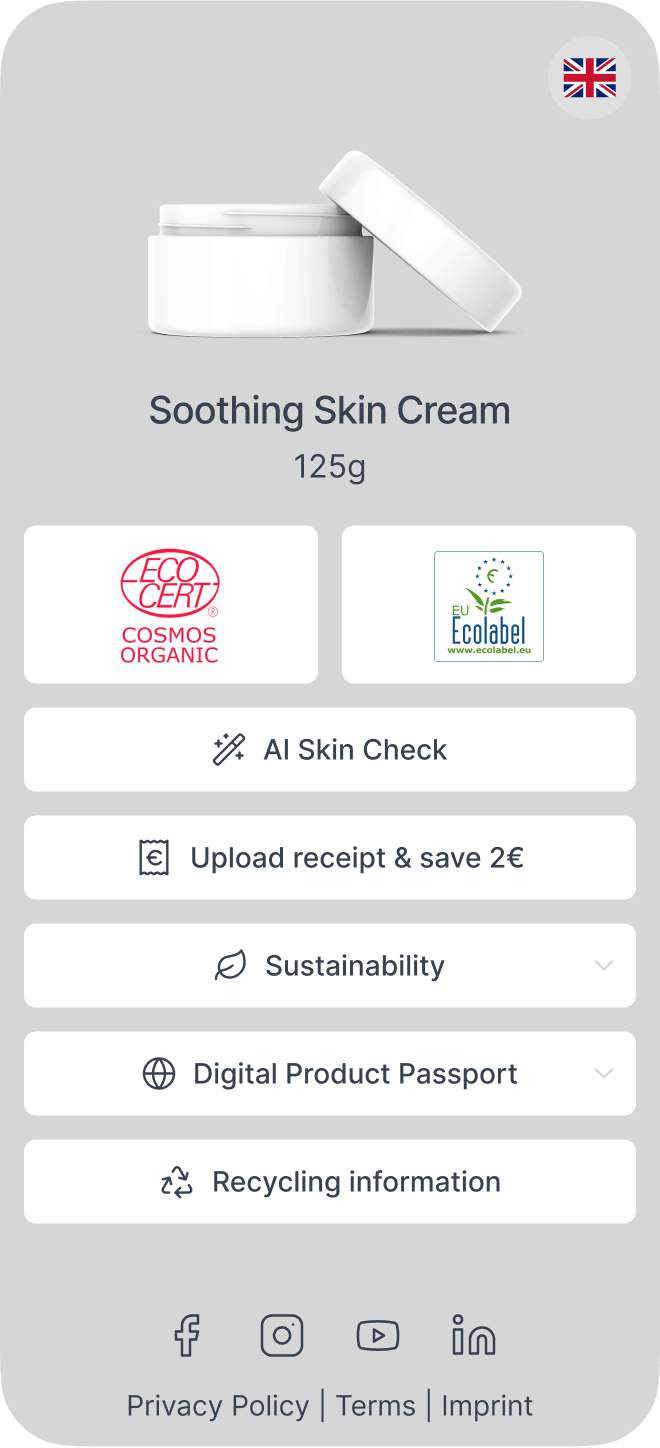
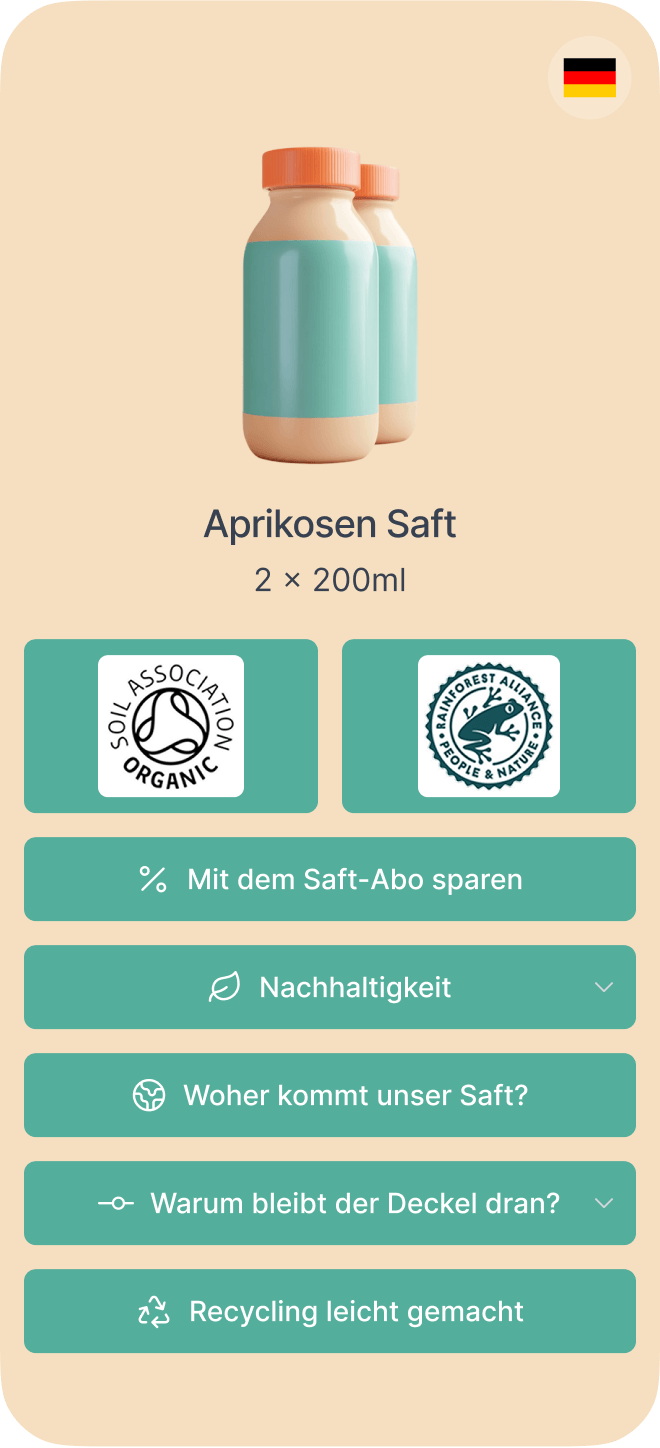
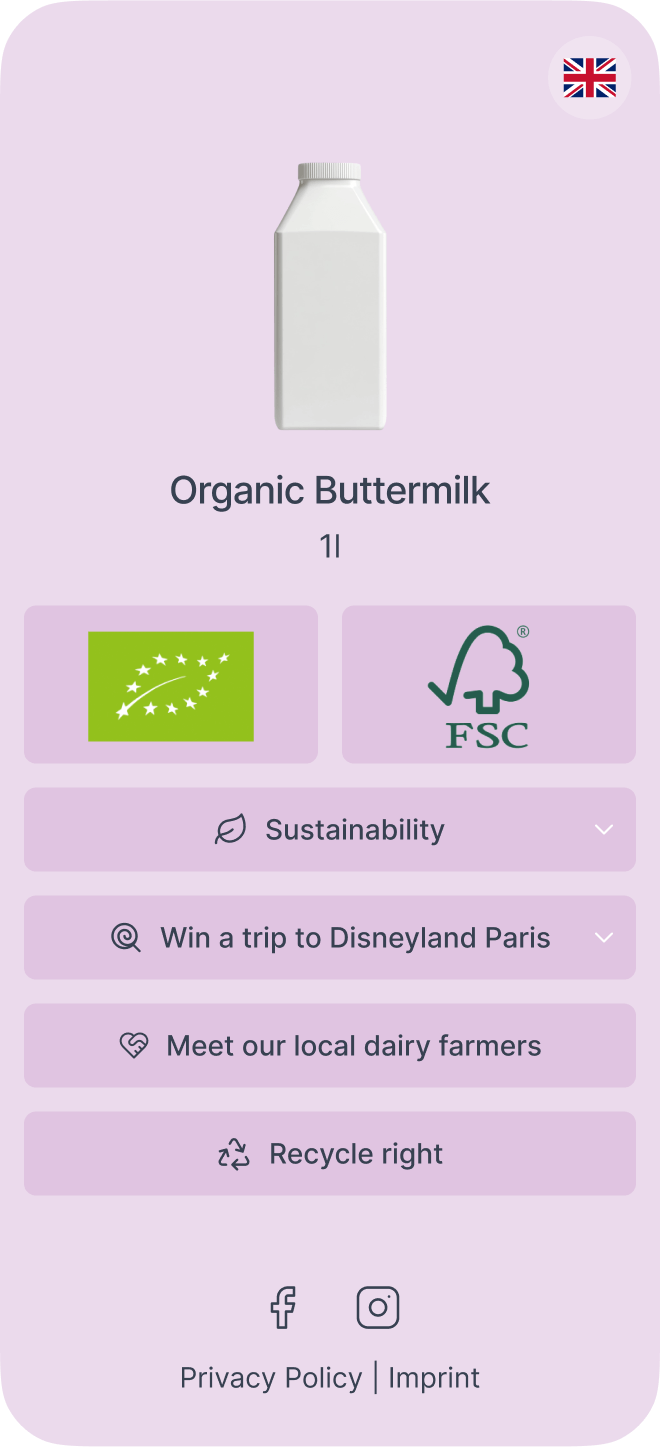
One GS1 Digital Link QR code can carry manufacturer details, label information and conformity documents in one place. See how info.link/labels supports this, or read our GS1 Digital Link guide.
Key dates
The core duties apply since August 12, 2026, and most sustainability targets follow from 2030. German deadlines run partly earlier.
- February 11, 2025: The PPWR entered into force (European Commission, 2026, Section I).
- August 12, 2026: The PPWR applies. PFAS limits for food contact packaging, manufacturer and importer duties (Art. 15, 18) and the VerpackDG apply. In Germany, fines for national duties such as registration and system participation apply (European Parliament & Council, 2025, Art. 71; VerpackDG, 2026, § 66(1)).
- September 12, 2026: Germany: producers newly obliged to register had to be registered in LUCID (VerpackDG, 2026, § 68(2)).
- November 12, 2026: Germany: registered producers report necessary changes (VerpackDG, 2026, § 68(2)).
- December 31, 2026: Germany: system participations concluded before August 12, 2026 continue until this date at the latest (VerpackDG, 2026, § 68(1)).
- February 12, 2027: Germany: fines for direct PPWR violations apply (VerpackDG, 2026, § 68(17)). Hospitality businesses must let customers bring their own container (European Parliament & Council, 2025, Art. 32). The Commission publishes guidelines on Annex V (European Commission, 2026, XII.1).
- December 31, 2027: Germany: producers of packaging that is not subject to system participation may supply it without ZSVR approval until this date (VerpackDG, 2026, § 68(9)).
- February 12, 2028: Tea and coffee bags and sticky labels on fruit and vegetables must be compatible with industrial composting (Art. 9(1)). Hospitality businesses must offer reusable take-away packaging (Art. 33). The Commission adopts the empty space methodology (Art. 24(2)) (European Parliament & Council, 2025).
- August 12, 2028, or 24 months after the implementing acts if later: The harmonised sorting label applies (European Parliament & Council, 2025, Art. 12(1)).
- January 1, 2030: Annex V formats are restricted (Art. 25). Reuse targets start (Art. 29) on this date or 18 months after their implementing act, whichever is later. Recycled content targets and the 50% empty space limit start on this date or three years after their implementing acts, whichever is later (European Parliament & Council, 2025; European Commission, 2026, X.2).
- February 12, 2032: The Commission reviews empty space rules for sales packaging, for example cosmetics (European Parliament & Council, 2025, Art. 24(6)).
1. Manufacturer or producer: which role do you have?
You are the manufacturer if your name or trademark is on the packaging or the packed product. The producer is the company that carries extended producer responsibility (EPR) in the Member State where the packaging becomes waste. Often both are the same company.
In the PPWR, the manufacturer (German: Erzeuger) is defined in Art. 3(1) point 13 and the producer (German: Hersteller) in point 15 (European Parliament & Council, 2025; Deutscher Industrie- und Handelskammertag, 2025). The manufacturer is responsible for conformity (Zentrale Stelle Verpackungsregister, n.d.-b). Five situations decide who the manufacturer is:
- Your name or trademark is on the pack or packed product, also if you only choose a standard packaging option: You are the manufacturer, even if another trademark is visible (European Commission, 2026, II.6).
- Retailer own brand: The retailer is the manufacturer, even if the filler is also named on the pack (Zentrale Stelle Verpackungsregister, 2026).
- One company's name and another company's trademark: The company that decides the packaging design is the manufacturer, checked case by case (European Commission, 2026, II.7).
- Custom transport packaging without a brand: The company that orders it and decides the design is the manufacturer (European Commission, 2026, X.14).
- The manufacturer is a microenterprise and the supplier sits in the same Member State: The supplier is the manufacturer (European Commission, 2026, X.3).
The manufacturer stays legally responsible. It can hand tasks to third parties, for example a laboratory or an authorised representative, but it cannot transfer the responsibility by contract (European Commission, 2026, X.9). Suppliers must provide the documents the manufacturer needs (European Parliament & Council, 2025, Art. 16).
In Germany, producers register in LUCID and take part in a dual system (Zentrale Stelle Verpackungsregister, n.d.-a). Distributors may not supply packaging if the producer is not registered or has no system participation (VerpackDG, 2026, § 13(3)). Foreign producers without a German branch that sell directly to end customers must appoint an authorised representative for EPR before they first supply packaging in Germany (Zentrale Stelle Verpackungsregister, n.d.-a).
2. What applies to every sector
Every manufacturer has to identify the packaging, state who it is, keep documentation and check environmental claims. Importers and distributors share these duties. For small packs, see our guide on QR codes and the PPWR for small packaging. For physical versus digital information, see mandatory information on packaging.
- Manufacturer details (Art. 15(5) and (6)): Packaging needs a type, batch or serial number. It also needs the manufacturer's name, trade name or trademark, a postal address and, where available, electronic contact. The details go on the pack, in a QR code, in a QR code on grouped packaging, or in an accompanying document (European Commission, 2026, X.13).
- When accompanying documents work: For packaging manufactured after August 12, 2026, only if the size or nature of the pack does not allow the details on the pack. For packaging already produced and in stock but not yet placed on the market, accompanying documents are possible, and it need not be destroyed or relabelled (European Commission, 2026, X.5, X.7).
- Old stock: Packaging placed on the market before August 12, 2026 can stay on the market, even if it does not comply (European Commission, 2026, X.5).
- No need to mark every part: For a yoghurt cup with lid and sleeve, one component is enough. Identification can refer to a type or production batch (European Commission, 2026, X.8).
- Documentation: Keep technical documentation for 5 years for single-use and 10 years for reusable packaging (European Parliament & Council, 2025, Art. 15(3), 18(7); European Commission, 2026, X.10).
- Importers: Since August 12, 2026, importers must check that the third-country manufacturer completed the conformity assessment, drew up the declaration and met Art. 15(5) and (6). They add their own name and address on the pack or in an accompanying document (European Commission, 2026, X.11).
- Digital labels (Art. 12(5)): If the label does not fit on the pack, it goes on the grouped packaging. If that is not possible either, the information goes in one electronically readable code. Online buyers must see it before buying. It must be in a language end users understand, as set by the Member State. The code may collect personal data only to give access to the conformity information, and the information must not appear together with sales or marketing content (European Parliament & Council, 2025, Art. 12(5)).
- Claims: Claims on recyclability, recycled content, reusability or compostability fall under Art. 14 PPWR. They must go beyond the minimum PPWR requirement and say whether they refer to the whole packaging unit or a part of it (European Commission, 2026, IX.1). Other environmental claims follow the Empowering Consumers Directive (European Parliament & Council, 2024). In Germany, the amended UWG has applied since September 27, 2026 (Carl, 2026).
- Enforcement: Authorities must first ask you to end a non-compliance and should support you before taking further action (European Commission, 2026, XVI.1).
- Fines in Germany: The VerpackDG sets fines of up to €200,000, €100,000 or €10,000, depending on the violation (VerpackDG, 2026, § 66). Fines for national duties such as registration and system participation apply since August 12, 2026. Fines for direct PPWR violations apply from February 12, 2027 (VerpackDG, 2026, § 68(17)). They reach up to €10,000 for Art. 15(5) and (6), 18(3), 24(1) and 25(1), and up to €200,000 for Art. 29(1), (5) and (6), 32(1) and 33(1) (VerpackDG, 2026, § 66(3)).
3. PPWR for food and beverages
Food contact packaging must stay below the PFAS limits since August 12, 2026. Single-use plastic formats in hospitality are restricted from 2030.
- PFAS: Since August 12, 2026, food contact packaging must not contain PFAS at or above 25 ppb for any single PFAS or 250 ppb for the sum of PFAS. A third limit of 50 ppm applies to PFAS including polymeric PFAS, measured as total fluorine (European Parliament & Council, 2025, Art. 5(5); Deutscher Industrie- und Handelskammertag, 2025). The limits apply to the packaging unit as a whole, including inks, varnishes and adhesives, and to intentionally added and unintentionally present PFAS. They apply to food contact packaging only. The Commission publishes no list of PFAS, and no harmonised test method exists yet (European Commission, 2026, III.12, III.16 to III.19).
- Heavy metals: The combined limit for lead, cadmium, mercury and hexavalent chromium is 100 mg/kg. It applies to all packaging from August 12, 2026 and is not a new obligation (European Parliament & Council, 2025, Art. 5(4); European Commission, 2026, III.10, III.12).
- Food law is not enough: Information under the Food Information Regulation does not automatically meet Art. 15(5) and (6). The responsible food business operator and the packaging manufacturer may be different companies (European Commission, 2026, X.13).
- Recycled content: From 2030, or three years after the implementing act, contact-sensitive PET needs 30%, other contact-sensitive plastics 10%, and single-use plastic beverage bottles 30% (Deutscher Industrie- und Handelskammertag, 2025; European Commission, 2026, X.2). You may claim a recycled content share only if it exceeds these targets (European Commission, 2026, IX.2).
- Annex V from January 1, 2030: Single-use plastic packaging for food and drinks consumed on hospitality premises is restricted. This includes sports venues, festivals and hotel room service. Hospitality businesses without drinking water are exempt (European Commission, 2026, XII.7, XII.8). Single-use plastic packaging for condiments, preserves, sauces, coffee creamer, sugar and seasoning is restricted in hospitality too. Exceptions cover take-away food for immediate consumption and healthcare (European Commission, 2026, XII.3).
- Delivery outside the premises: The ban does not apply, but take-away duties do. From February 12, 2027, hospitality businesses must let customers bring their own container. From February 12, 2028, they must offer take-away products in reusable packaging (European Parliament & Council, 2025, Art. 32, 33; European Commission, 2026, XII.8).
- Germany: Deposit systems for beverage packaging stay in place (Umweltbundesamt, 2026).
4. PPWR for fresh produce and horticulture
Single-use plastic packaging for pre-packed fresh fruit and vegetables under 1.5 kg is restricted from January 1, 2030, and growers can be producers under the PPWR.
- Plastic packaging for fresh produce (Annex V): From January 1, 2030, single-use plastic packaging for pre-packed fresh fruit and vegetables under 1.5 kg is restricted. Member States may allow exemptions if there is a demonstrated need, for example to avoid water loss, microbiological hazards or physical shocks. The Commission publishes guidelines with a list of excluded fruit and vegetables by February 12, 2027 (European Commission, 2026, XII.1, XII.2; European Parliament & Council, 2025, Annex V).
- Stickers: Sticky labels on fruit and vegetables must be compatible with the industrial composting standard from February 12, 2028 (European Parliament & Council, 2025, Art. 9(1); Deutscher Industrie- und Handelskammertag, 2025).
- Growers as producers: A farmer who packs apples under their own name and sells in the same Member State is a producer. A farmer who sells under their own name to a retailer in another Member State is not. A farmer who is a microenterprise can be treated differently if the supplier of the container is in the same Member State. If the pack carries a cooperative's name, the cooperative is the producer (European Commission, 2026, II.8).
- Plants and flowers: The horticulture association ZVG welcomed that batch or serial number and manufacturer details can initially appear in delivery notes (Zentralverband Gartenbau, 2026). The Commission's FAQ is narrower. For stock produced before August 12, 2026, accompanying documents are possible. For packaging made afterwards, they are allowed only if the pack cannot carry the details (European Commission, 2026, X.5, X.7). For small pots, a QR code on the pack is the practical route.
5. PPWR for cosmetics and personal care
Small cosmetic packs can move label information to a QR code, and hotel miniatures for individual bookings are restricted from 2030.
- Small packs: Many packs cannot carry text. Art. 12(5) lets you move label information to the grouped packaging or to one electronically readable code. Art. 15(6) allows manufacturer details in a QR code (European Commission, 2026, X.13).
- Hotel miniatures (Annex V, from January 1, 2030): Single-use accommodation packaging for an individual booking is restricted. Miniatures sold on demand or at the hotel are not exempt. Only the packaging is banned, not the product (European Commission, 2026, XII.6).
- Empty space in sales packaging: The PPWR sets no maximum. You must minimise the empty space and show this in the technical documentation. The Commission reviews special rules for cosmetics by February 12, 2032 (European Commission, 2026, XI.2; European Parliament & Council, 2025, Art. 24(4), (6)).
- Claims: Environmental claims on cosmetic packs also fall under Art. 14 and the Empowering Consumers Directive (European Commission, 2026, IX).
6. PPWR for cleaning and detergent products
Cleaning products follow the PPWR for packaging and the new Detergents Regulation for product information, so one digital code can serve both.
- Detergents Regulation: Regulation (EU) 2026/405 applies from September 23, 2029, except Art. 4(3) and (4). It replaces Regulation (EC) No 648/2004 and makes room for digital safety and use information (European Parliament & Council, 2026). Plan one code that can serve both the PPWR and the Detergents Regulation. See our detergent and CLP guide.
- Refill: Sellers who offer refill must inform buyers about suitable containers and hygiene rules. Stores above 400 m² should dedicate 10% of their sales area to refill from 2030 (European Parliament & Council, 2025, Art. 28; Deutscher Industrie- und Handelskammertag, 2025).
- Reuse targets: They start January 1, 2030, or 18 months after the implementing act, which is due by June 30, 2027 (European Commission, 2026, X.2).
7. PPWR for supplements
Supplements follow food labelling rules first, and the PPWR adds duties on top. The pharma exemption does not cover them.
- Food law first: The manufacturer's name in the food information does not automatically meet Art. 15(6) (European Commission, 2026, X.13).
- Small bottles and blister packs: Use the fall-back chain in Art. 12(5) for labels and Art. 15(6) for manufacturer details (European Commission, 2026, X.13).
- Pharma exemption (Art. 12(11)): It covers immediate and outer packaging of medicinal products for humans and animals and of medical devices under Regulations (EU) 2017/745, (EU) 2017/746 and (EU) 2019/6 and Directive 2001/83/EC. It applies only if no space is left because of other labelling rules, or if the label could jeopardise the safe use of medicinal products (European Parliament & Council, 2025, Art. 12(11)). Supplements are not covered unless authorised as medicinal products.
- Claims: Health claims follow separate rules. Environmental claims on the pack follow Art. 14 and the Empowering Consumers Directive (European Commission, 2026, IX).
8. PPWR for online retail and shipping
Shipping packaging counts as e-commerce packaging, and platforms and fulfilment providers must check your EPR registration before you sell.
- Shipping packaging is e-commerce packaging. It is a special form of transport packaging used for distance sales (European Commission, 2026, II.4). Cartons, bags, tape, labels and fillers all count (Zentrale Stelle Verpackungsregister, n.d.-c).
- Several manufacturers in one shipment: Each manufacturer provides its own documentation (European Commission, 2026, II.5).
- Germany: Shipping packaging always needs system participation (Zentrale Stelle Verpackungsregister, n.d.-c).
- Platforms and fulfilment providers: Online platforms must obtain proof of your EPR registration in the destination country and a self-certification before you can sell (European Parliament & Council, 2025, Art. 45; European Commission, 2026, XVIII.5). In Germany, fulfilment providers may not handle your packaging unless you are registered in LUCID (VerpackDG, 2026, § 13(4)).
- Empty space: The 50% limit applies to whoever fills the packaging. It starts January 1, 2030, or three years after the implementing act, which is due by February 12, 2028 (European Parliament & Council, 2025, Art. 24(1); European Commission, 2026, XI.1, XI.4).
- Reuse targets: Targets also cover e-commerce packaging, from 2030 (European Parliament & Council, 2025, Art. 29).
9. What is still unclear
Five points are still open, mostly because the Commission has not yet published implementing acts or guidelines.
- Pictogram design and data carrier details: The Commission has not published them yet. The label applies from August 12, 2028 or 24 months after the implementing acts, whichever is later. Do not print a final label yet (Umweltbundesamt, 2026).
- Annex V details: The exact scope, examples and exemptions will come in the Commission guidelines due by February 12, 2027 (European Commission, 2026, FAQ XII.9).
- PFAS testing: A harmonised test protocol for food contact packaging is still in development (European Commission, 2026, FAQ III.19).
- Calculation rules for recycled content and reuse: The Commission is due to adopt the recycled content methodology by December 31, 2026 and the reuse calculation by June 30, 2027 (European Commission, 2026, FAQ IX.2 and X.2).
- Further changes in Germany: The VerpackDG will need more amendments once the Commission adopts its secondary legislation (Umweltbundesamt, 2026).
10. What to do now
Start with your role, your pack data and, in Germany, your LUCID and system participation.
- Write down your role for each product: manufacturer, producer, importer.
- Add manufacturer details under Art. 15(5) and (6) to every pack, to a QR code or, where allowed, to accompanying documents (European Parliament & Council, 2025, Art. 15).
- Prepare the technical documentation (Annex VII) and the EU declaration of conformity (European Parliament & Council, 2025, Art. 38 and 39).
- In Germany, check your LUCID registration. New producers had to register by September 12, 2026. Existing producers report changes by November 12, 2026 (VerpackDG, 2026, § 68(2)).
- In Germany, check your system participation. Contracts concluded before August 12, 2026 apply at most until December 31, 2026 (VerpackDG, 2026, § 68(1)).
- If you are a foreign producer without a German branch, appoint an authorised representative for EPR (Zentrale Stelle Verpackungsregister, n.d.-a).
- Ask suppliers for PFAS declarations on food contact packaging (European Parliament & Council, 2025, Art. 5(5)).
- Review environmental claims on packs against Art. 14 and the Empowering Consumers Directive (European Parliament & Council, 2024).
- Plan one GS1 Digital Link QR code that can serve several laws. See our GS1 Digital Link guide.
References
Carl, M. (2026, September 28). Greenwashing verboten: EmpCo und geändertes UWG in Kraft. IHK Lippe zu Detmold.
Deutscher Industrie- und Handelskammertag. (2025). Merkblatt: Die neue europäische Verpackungsverordnung, VO (EU) 2025/40.
European Commission. (2026, August). Packaging and Packaging Waste Regulation (PPWR): Frequently asked questions (2nd ed.). Directorate-General for Environment.
European Parliament & Council of the European Union. (2024). Directive (EU) 2024/825 on empowering consumers for the green transition.
European Parliament & Council of the European Union. (2025). Regulation (EU) 2025/40 on packaging and packaging waste. Official Journal of the European Union, L, 2025/40.
European Parliament & Council of the European Union. (2026). Regulation (EU) 2026/405 on detergents and surfactants.
Umweltbundesamt. (2026, August 11). Neue Regeln für Verpackungen bringen Plus für Umwelt & Gesundheit.
VerpackDG. (2026, July 13). Gesetz zur Durchführung der Verordnung (EU) 2025/40 betreffend Verpackungen. Bundesgesetzblatt 2026 I Nr. 207.
Zentrale Stelle Verpackungsregister. (n.d.-a). PPWR & VerpackDG: Das gilt seit dem 12. August 2026.
Zentrale Stelle Verpackungsregister. (n.d.-b). PPWR: Wer ist Erzeuger und Hersteller?.
Zentrale Stelle Verpackungsregister. (n.d.-c). Verpackungsrechtliche Pflichten und Onlinehandel.
Zentrale Stelle Verpackungsregister. (2026, August 12). Zweite Fassung der PPWR-FAQ: Klarstellung zur Erzeugereigenschaft bei Eigenmarken des Handels.
Zentralverband Gartenbau. (2026, July 16). PPWR: Kennzeichnung vorerst über Begleitdokumente möglich. Der Deutsche Gartenbau.
About the author Max Ackermann
Max Ackermann is founder and Managing Director of info.link, the product data platform that makes brands visible in AI search and connects every physical product to the web through GS1 Digital Link. He writes about AI search and generative engine optimization (GEO), AI-powered commerce, and how brands can structure product data for ChatGPT, Gemini, Perplexity, and retailer AI assistants like Amazon Rufus. For the past two years he has built the pipelines that put structured product data into AI answers, and run the experiments that test what actually moves AI citations.
Max has 20+ years of experience building digital products and businesses. He previously led McKinsey's Corporate Venture and Design teams across Europe, and as Managing Director of a leading US digital agency he built platforms with Nike, Google, Meta, and Airbnb. He founded the UX Design program at Central Saint Martins College, University of the Arts London, and is a Fellow of the UK's Higher Education Academy. Based in Hamburg, he works closely with GS1 on Digital Link adoption; info.link is headquartered in Hamburg and Berlin and counts GS1 Germany among its investors.
Follow Max on LinkedIn.