STI Group and info.link premiere a smart packaging demo box at the Printed Packaging Summit 2026

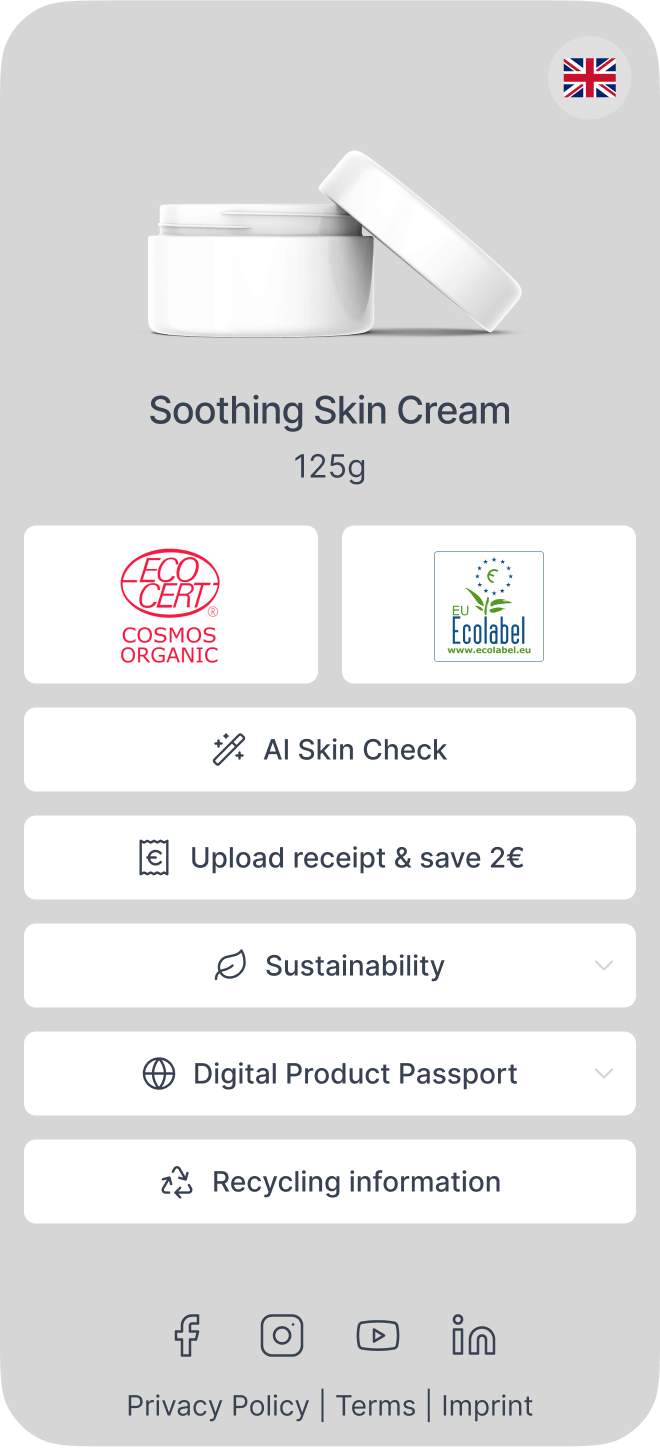
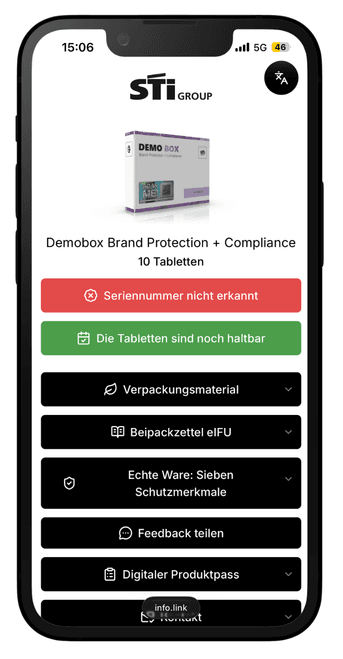
How do you launch a smart packaging solution? You let people experience it. At the Printed Packaging Summit in Cologne, STI Group and info.link premiered a new demo box for anti-counterfeiting and compliance. One GS1 Digital Link on the box opens a digital label that authenticates the product, checks its validity, shows the expiry date, warns about a recalled batch, gives recycling advice by country and opens the electronic instructions for use (eIFU).
Less PowerPoint, more hands-on
Instead of slides, the team put a demo box on every table. Participants from across Europe and the US scanned the code and explored the label themselves, each in their own language. "Less PowerPoint. More hands-on experience," as Claudia Rivinius of STI Group put it on LinkedIn. Christoph Goeken of info.link presented the box together with STI.
The team also showed how a GS1 Digital Link can be combined with AI. This makes product information easier to access and opens new ways to interact with a pack.
What is a digital label on packaging?
A digital label is a web page that opens when you scan the code on a pack. It holds everything a printed label has no room for, and it can be updated without reprinting the box. In this demo the code is a GS1 Digital Link: one web address that carries the product number (GTIN), batch, serial number, production date and expiry date (GS1, 2026).
What makes it different
Most packs carry a printed label or a QR code that opens the same page for every box. This one works differently.
- Every box is unique: batch and serial number turn each pack into its own digital identity.
- The page reacts to the pack: a valid code gets a green check, a wrong code gets an invalid message.
- It stays up to date: content and warnings change without reprinting a single box.
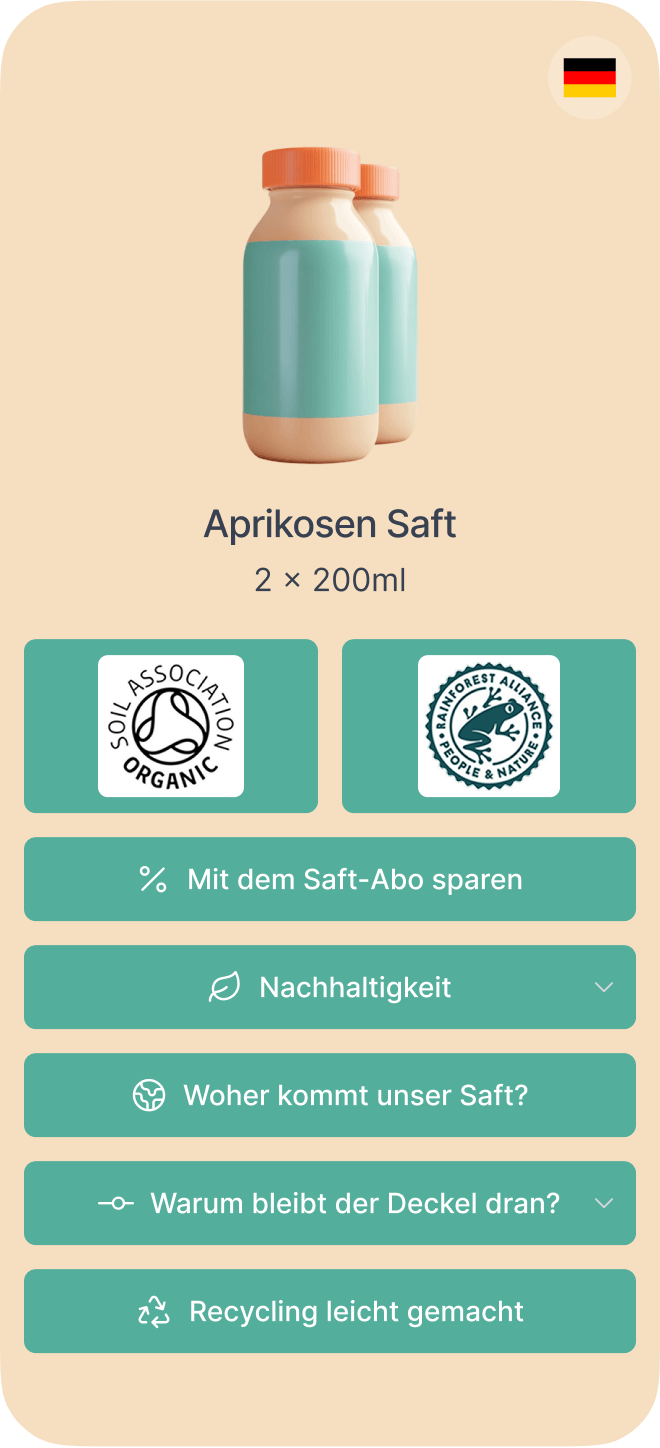
- It speaks the shopper's language: content and recycling advice fit the country.
- One entry point for everything: protection, compliance, sustainability and customer engagement connect through one link.
- It is built on a global standard: GS1 Digital Link is made to work with retail scanners and web browsers (GS1, 2026).
- It is protected: a laser code, a hidden mark and a brand protection layer work together.
- It is green by design: a fibre blister replaces plastic, and the label backs eco claims with evidence.
What one scan shows
Scan the box and the label opens in the shopper's language. It knows exactly which pack it is looking at.
- Product authentication and validity check: a clear green check for a valid pack.
- Expiry date: shown for this exact pack.
- Recall warning: a recalled batch triggers a clear message.
- Recycling advice: sorted by country.
- Electronic instructions for use (eIFU): one tap away.
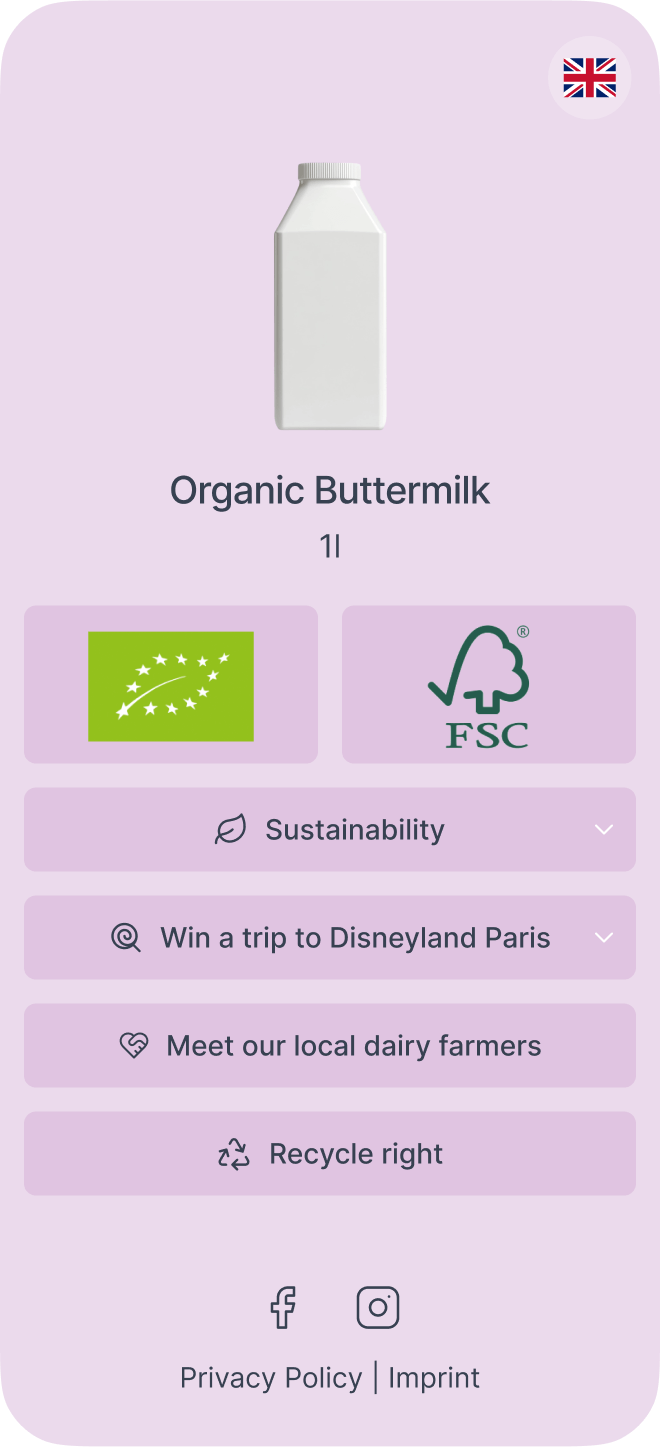
- Green claim with evidence: sustainability claims come with proof.
- Product story: text and images that explain the product.
- Customer feedback: a quick survey for the shopper.
- Brand communication: direct links to social media.
- AI: product information that is easier to access and to ask about.
More is possible. The same label can play videos and show Instagram or TikTok posts, so a pack can also tell a brand story.
Four scans, four stories
- The shopper in the store scans the box and sees the expiry date, recycling advice for their own country and a short product video.
- The recalled batch: a pack from an affected batch shows a warning instead of a green check. The brand reacts without reprinting a single box.
- The patient at home opens the electronic instructions for use in their own language, in one tap (see European Medicines Agency, 2020).
- The suspicious pack: a copied or wrong code fails the check and shows an invalid message. Together with the hidden mark and brand protection layer, this makes fakes easier to spot.
The partners behind the box
Each partner brings one piece of the puzzle.
- STI Group: folded the box at its Lauterbach site (STI Group, 2026).
- Domino: laser coded every pack with its own batch and serial number.
- KURZ SCRIBOS: brand protection that works with GS1 codes (KURZ SCRIBOS, 2026).
- AlpVision: Cryptoglyph, a hidden laser mark that helps authenticate a pack (AlpVision, 2021).
- PulPac: dry molded fibre blisters as a fibre based alternative to plastic (Packaging Insights, 2022).
- info.link: the digital label behind the scan.
Why it matters
Smart packaging is much more than a QR code. It turns a pack into a digital touchpoint for product protection, compliance, sustainability and customer engagement. The timing fits: retail is moving to 2D codes based on GS1 Digital Link under the Sunrise 2027 plan, and large platforms already ask brands for scannable product data (Packaging World, 2025). New EU packaging rules (PPWR) call for clear labels (Marsh, 2026), and in pharma the leaflet is going digital (European Medicines Agency, 2020).
What brands can do with it
The idea fits any pack with a GTIN:
- Beauty: batch warnings, ingredient and shade info, video routines, feedback after purchase.
- Electronics: manuals, repair and recycling advice, proof of origin.
- Pharma: electronic instructions for use, expiry check and recall warning.
- Beverage: deposit and recycling rules by country, origin story, social content.
References
AlpVision. (2021, August 5). Laser engraved Cryptoglyph. https://alpvision.com/laser-engraved-cryptoglyph/
European Medicines Agency. (2020, January 29). Key principles for the use of electronic product information in EU medicines. https://www.ema.europa.eu/en/news/key-principles-use-electronic-product-information-eu-medicines
FACHPACK. (2026). FACHPACK 2027. https://www.fachpack.de/en
GS1. (2026). GS1 Digital Link. https://www.gs1.org/standards/gs1-digital-link
KURZ SCRIBOS. (2026). Brand protection with GS1 and the digital product passport in mind. https://www.scribos.com/blog/brand-protection-with-gs1-and-the-digital-product-passport-in-mind
Marsh, P. (2026, August 19). EU misses deadline for PPWR labelling rules. Envirotec. https://envirotecmagazine.com/2026/08/19/eu-misses-deadline-for-ppwr-labelling-rules/
Packaging Insights. (2022, December 7). PulPac forms blister pack collective to fight pharma industry waste. https://packaginginsights.com/news/pulpac-forms-blister-pack-collective-to-fight-pharma-industry-waste.html
Packaging World. (2025, September 8). Sunrise 2027: Amazon's Transparency program to rewrite product packaging rules. https://www.packworld.com/coding-printing-labeling/coding-marking/article/22949552/sunrise-2027-amazons-transparency-program-rewrite-product-packaging-rules
Paris Packaging Week. (2026). Paris Packaging Week 2027. https://www.parispackagingweek.com/en/
Scanpack. (2026). Scanpack 2027. https://scanpack.se
STI Group. (2026). Dynamic Digital Label. https://www.sti-group.com/en/dynamic-digital-label.html
About the author Max Ackermann
Max Ackermann is founder and Managing Director of info.link, the product data platform that makes brands visible in AI search and connects every physical product to the web through GS1 Digital Link. He writes about AI search and generative engine optimization (GEO), AI-powered commerce, and how brands can structure product data for ChatGPT, Gemini, Perplexity, and retailer AI assistants like Amazon Rufus. For the past two years he has built the pipelines that put structured product data into AI answers, and run the experiments that test what actually moves AI citations.
Max has 20+ years of experience building digital products and businesses. He previously led McKinsey's Corporate Venture and Design teams across Europe, and as Managing Director of a leading US digital agency he built platforms with Nike, Google, Meta, and Airbnb. He founded the UX Design program at Central Saint Martins College, University of the Arts London, and is a Fellow of the UK's Higher Education Academy. Based in Hamburg, he works closely with GS1 on Digital Link adoption; info.link is headquartered in Hamburg and Berlin and counts GS1 Germany among its investors.
Follow Max on LinkedIn.